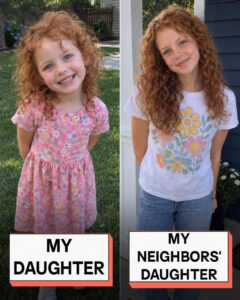
The girl next door knew a lullaby no stranger should have known
By the time I reached the back door, my husband was already screaming our daughter’s name.
“Margot!”
I dropped the wooden spoon I was holding and ran outside.
Ten years ago, that Saturday had begun so peacefully that remembering it still makes me angry.
I had been making lunch. Daniel and our four-year-old daughter, Margot, were playing in the backyard. Through the open kitchen window I could hear her laughing every time Daniel pushed her too high on the little red swing.
“Again, Daddy!”
“You’re going to fly over the fence.”
“Again!”
I remember smiling as I sliced tomatoes.
Seven minutes later, she was gone.
The swing was still moving.
The side gate stood open.
Daniel was barefoot in the grass, shouting her name.
“What happened?”
“I went into the garage for maybe a minute.”
“A minute?”
“I came back and she wasn’t here.”
I ran toward the gate.
“Margot!”
Nothing.
Daniel grabbed my arm.
“I already checked the street.”
“Then check again!”
For the next hour, our quiet neighborhood became a sea of police cars, volunteers and dogs.
By evening, Margot’s photograph was everywhere.
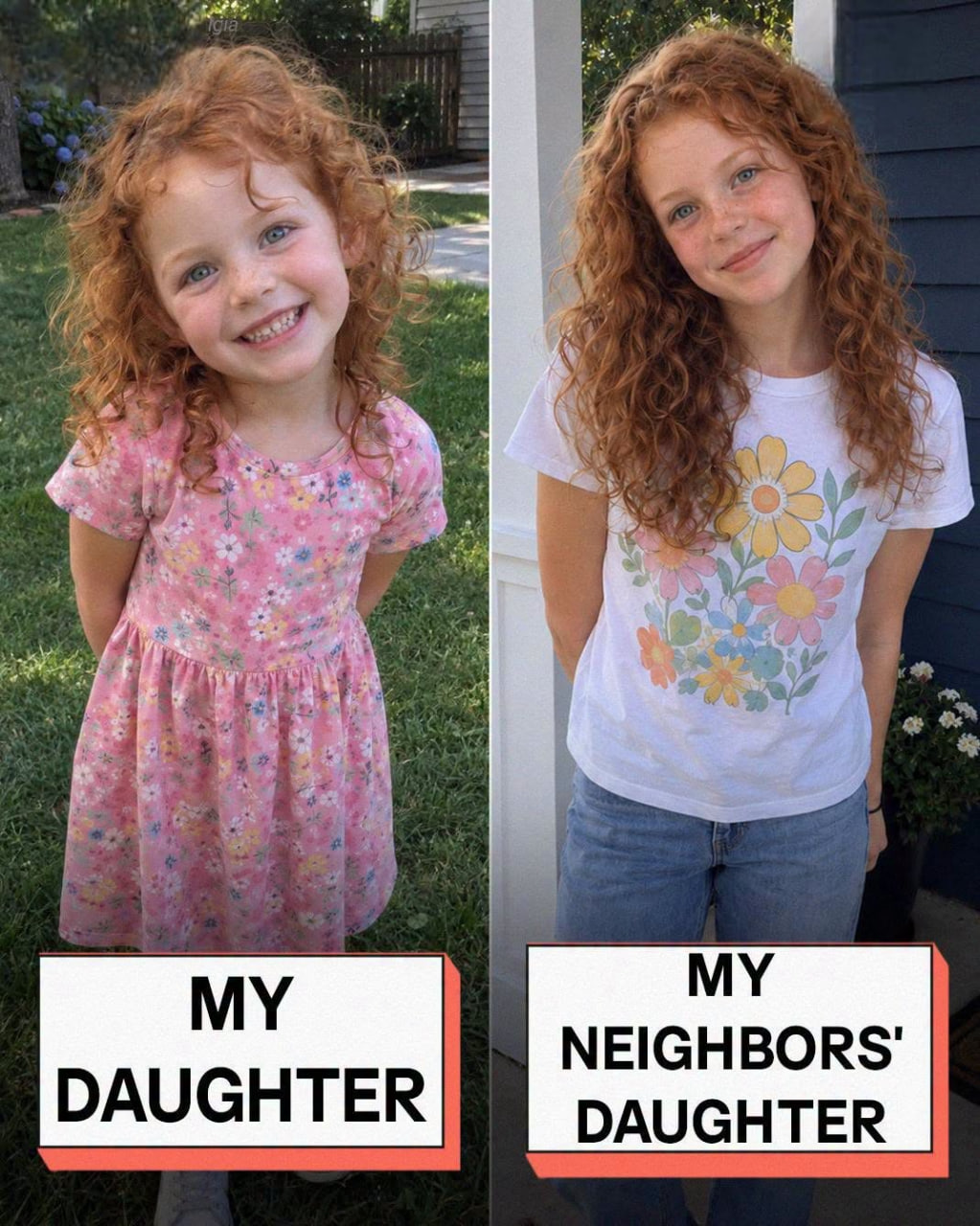
Four years old.
Red curls.
Blue-green eyes.
Pink flowered dress.
One front tooth slightly crooked because she had fallen from her scooter two weeks earlier.
There was also a thin crescent-shaped scar on the inside of her left wrist from the previous Christmas, when she had broken a glass ornament trying to hang it by herself.
I described that scar to the police until I could see it when I closed my eyes.
No one found her.
A camera three streets away showed a dark SUV passing at 12:38.
Too blurry to read the plate.
A neighbor thought she heard a child cry.
Another swore she saw a blonde woman near our fence.
Neither lead went anywhere.
Daniel and I stopped being husband and wife almost immediately.
We became two people trapped inside the same disaster.
He blamed himself because he had gone into the garage.
I blamed him because he had gone into the garage.
Then I blamed myself for blaming him.
Then I blamed myself for making lunch.
Grief is cruel that way. It turns ordinary acts into crimes.
For two years we stayed together because separating felt like admitting Margot was never coming home.
Then Daniel moved out.
“I can’t breathe in this house,” he said.
Neither could I.
But I stayed.
If Margot somehow found her way back, I wanted the front door to be the same.
Every birthday, I bought one small gift.
At five, colored pencils.
At six, a book about horses.
At seven, a silver bracelet.
By fourteen, there were ten unopened packages in the bottom drawer of my bedroom dresser.
People eventually stopped asking if there was news.
The detective assigned to her case retired.
His replacement called every few months at first, then twice a year.
I learned to function.
I did not learn to stop waiting.
Then, ten years after Margot vanished, the house next door was sold.
The new neighbor introduced herself as Naomi Reed.
She was forty-something, divorced, friendly without being intrusive. She had moved from another state after accepting a position at the local hospital.
“We’re still living out of boxes,” she told me on the sidewalk. “My daughter is convinced unpacking is a human-rights violation.”
I smiled politely.
Then the daughter stepped outside.
And my body forgot how to breathe.
She was fourteen.
Tall.
Long red curls.
Blue-green eyes.
Freckles across the bridge of her nose.
I told myself not to be ridiculous.
Millions of people had red hair.
Millions had light eyes.
My grief had played this trick before. In supermarkets. Airports. School parking lots.
For ten years, every red-haired girl had become Margot for half a second.
Naomi touched the girl’s shoulder.
“This is Lily.”
Lily smiled.
Her left front tooth overlapped the right one just slightly.
Exactly the way Margot’s permanent tooth had been expected to grow based on her childhood dental X-rays.
My stomach turned.
“Hi,” Lily said.
I stared too long.
Naomi noticed.
“Are you okay?”
“Yes. Sorry. You just… remind me of someone.”
Lily’s smile faded.
I escaped into my house.
For the next week, I avoided them.
Then Lily knocked on my door.
“Sorry. Mom says your package got delivered to us.”
She handed me a box.
That was when I saw her wrist.
A pale crescent.
Inside left wrist.
Same place.
Same direction.
The box slipped from my hands.
Lily bent to pick it up.
“Are you sure you’re okay?”
“What happened to your wrist?”
She looked down.
“This?”
“Yes.”
She shrugged.
“No idea. I’ve had it forever.”
“How old were you when you got it?”
“I don’t remember.”
I must have looked terrifying, because she backed away.
“I should go.”
That night I pulled Margot’s old medical folder from the attic.
There it was.
Emergency-room report.
December 19.
Age three.
Four stitches.
Inside left wrist.
I called the detective assigned to Margot’s cold case.
Detective Elena Ruiz listened without interrupting.
When I finished, she said carefully:
“Claire, resemblance and a scar aren’t enough.”
“I know.”
“Have you spoken to the mother?”
“No.”
“Don’t accuse her.”
“I won’t.”
“Let me look into them first.”
The next morning, Lily was outside drawing with chalk on the driveway.
I heard her humming.
My knees nearly gave out.
It was a tune I had invented when Margot was a baby.
No radio song.
No nursery rhyme.
Just six notes and nonsense words about a moon boat carrying sleepy children across the sky.
Daniel used to make fun of me because the melody never resolved properly.
Lily hummed all six notes.
I stepped outside.
“Where did you learn that?”
She looked up.
“What?”
“That song.”
She seemed embarrassed.
“I don’t know.”
“Did your mother sing it?”
“No.”
“Your father?”
“I don’t really remember him.”
Then she frowned.
“I think I dreamed it when I was little.”
I went back inside and threw up.
Ruiz called that afternoon.
“Claire, I need you to sit down.”
I did.
“Naomi Reed’s daughter’s birth records are inconsistent.”
My mouth went dry.
“What does that mean?”
“According to current documents, Lily was born in Arizona fourteen years ago. But there’s no matching hospital record under that name.”
“And Naomi?”
“She became Lily’s legal guardian seven years ago after her sister died.”
“Sister?”
“Melissa Grant.”
The name meant nothing to me.
At least I thought it didn’t.
“Before that?”
“We’re still working on it.”
“Can you test her DNA?”
“Not without consent or stronger legal grounds.”
I could not sleep.
The following evening Naomi knocked on my door.
She was pale.
“Can we talk?”
I let her in.
She remained standing.
“Detective Ruiz called me.”
My heart hammered.
Naomi looked toward the window.
“Is your daughter’s name Margot?”
I gripped the back of a chair.
“Yes.”
She covered her mouth.
“Oh God.”
“What?”
Tears filled her eyes.
“My sister told me her name was Maggie.”
The room tilted.
“Who?”
“Lily.”
I could barely speak.
“Tell me everything.”
Naomi sat.
Her sister Melissa had arrived at her house in Colorado ten years earlier with a four-year-old child.
Melissa had always lived chaotically, drifting between relationships and jobs. She claimed the girl belonged to a man she had been seeing.
“She said the mother had died,” Naomi whispered. “She said the father couldn’t keep her because of legal trouble.”
“What father?”
“I never met him.”
“You never asked?”
“I did. Melissa always had answers.”
For three years, Melissa raised the child.
Then Melissa died in a car accident.
Naomi took Lily in.
“The documents were strange,” she admitted. “There was a delayed birth certificate. Temporary guardianship paperwork. Melissa said the father had arranged everything.”
“You believed her?”
“I wanted to.”
Her voice broke.
“I loved Lily by then.”
I stared at her.
“You suspected something.”
“Not kidnapping.”
“You knew something was wrong.”
“Yes.”
The honesty hurt more than denial would have.
I whispered:
“Why Lily?”
“She was already calling herself that by the time she came to live with me.”
“And before?”
Naomi swallowed.
“Maggie.”
Margot had called herself Maggie when she was four because she couldn’t pronounce Margot the way my French grandmother did.
I covered my face.
Naomi began crying.
“There’s something else.”
I looked at her.
“When Melissa died, I found a box of old things. I never understood them.”
She left and returned twenty minutes later carrying a plastic storage container.
Inside were drawings.
A faded pink sock.
A photograph of Melissa.
And a stuffed rabbit.
White once.
Now gray.
One ear shorter than the other because our dog had chewed it when Margot was two.
I made a sound I had never heard come from myself.
I picked it up.
Under the left foot, written in black marker, were two words.
MARGOT B.
My handwriting.
Naomi turned white.
“Oh my God.”
I held the rabbit to my chest.
Then Lily appeared in the doorway behind her.
She had followed her mother over.
She stared at the rabbit.
“That’s mine.”
No one spoke.
“I used to sleep with it.”
Naomi stood.
“Sweetheart…”
Lily looked from her to me.
Then she saw my face.
“What is happening?”
I could not answer.
Naomi did.
And I will always be grateful she did not lie again.
“We think your name might not have been Lily.”
The girl stared.
“My name is Lily.”
“Yes.”
“No. What do you mean?”
She looked at me.
“Why is she crying?”
I forced myself to speak.
“Because I had a little girl.”
Lily froze.
“She disappeared ten years ago.”
“No.”
“Her name was Margot.”
“No.”
“She had a scar on her wrist.”
“Stop.”
“She had that rabbit.”
“Stop!”
She ran home.
Naomi went after her.
I collapsed on my kitchen floor holding a stuffed animal I had not seen in ten years.
Two days later, after speaking with a child psychologist and Detective Ruiz, Lily agreed to a DNA test.
Not because I asked.
I refused to pressure her.
She told Ruiz:
“If everyone is already looking at me like I’m somebody else, I want to know.”
The results came six days later.
99.998 percent probability of a biological mother-child relationship.
Lily Reed was my daughter.
Margot was alive.
But when I thought the nightmare was finally over, Detective Ruiz placed one more photograph on my table.
It showed Daniel walking into a motel with Melissa Grant three months before Margot disappeared.
And suddenly I understood why, on the worst day of my life, my husband had known exactly which direction not to search.
Getting my daughter back meant discovering that the man who had searched beside me for years had helped make her disappear — and that loving Margot now required me not to erase the mother she had known for most of her life
I stared at the motel photograph until the faces blurred.
“That’s Daniel.”
Ruiz nodded.
“And Melissa?”
“Yes.”
“What does this prove?”
“By itself? An affair.”
My fingers went numb.
Daniel had denied ever knowing Melissa when police first questioned him after the DNA result.
Ruiz continued:
“But Naomi gave us access to Melissa’s storage box.”
She placed three photocopied letters on the table.
The first was dated five months before Margot disappeared.
Melissa’s handwriting.
You keep saying you want a life with me, but every time Claire calls, you run home.
The second was from Daniel.
I recognized his handwriting immediately.
I’m not leaving without Maggie.
My stomach clenched.
The third was worse.
Once she’s with you, keep driving. Do not stop at the house. I’ll call the police myself. If anyone asks, you’ve never met me.
I stopped reading.
“No.”
Ruiz said nothing.
“There has to be another explanation.”
“There may be more context.”
“No.”
I stood.
“He searched for her.”
“I know.”
“He put up posters.”
“I know.”
“He went on television.”
“I know.”
“He sat on her bedroom floor and cried until he couldn’t breathe.”
Ruiz waited.
Then said quietly:
“People can feel grief over consequences they created.”
I hated her for that sentence.
Because part of me knew she was right.
Daniel was living two states away now.
We had divorced eight years earlier.
He had remarried briefly and divorced again.
For ten years we had spoken only when something happened in the investigation.
On every one of Margot’s birthdays, he texted me:
Still thinking about her.
Now I understood how obscene that message was.
Police arrested him three days later after investigators found financial records connecting him to Melissa.
For years after Margot vanished, Daniel had sent money to accounts controlled by Melissa.
Small amounts.
Never enough to attract attention.
Sometimes through prepaid transfers.
Sometimes through a business owned by one of Melissa’s friends.
Naomi had not known.
Neither had I.
The truth took months to reconstruct.
Daniel eventually stopped denying it when faced with the letters, transactions and an old audio recording recovered from one of Melissa’s phones.
His story was pathetic in its cowardice.
He had been having an affair with Melissa for almost a year.
He told her he planned to leave me.
Melissa wanted him to bring Margot.
Daniel convinced himself I would “turn Margot against him” if he filed for divorce.
So he and Melissa created what he called a temporary plan.
Melissa would take Margot.
Hide her for several weeks.
Daniel would pretend she had been abducted.
Later he would leave me, reunite with Melissa somewhere far away and claim he had somehow found his daughter privately.
Even hearing it secondhand made no sense.
That was because it had never been a good plan.
It had been the fantasy of two selfish adults who believed they could control everyone around them.
“What went wrong?” I asked Ruiz.
“Daniel panicked.”
The disappearance became national news faster than they expected.
Police questioned him repeatedly.
Media surrounded our house.
Daniel realized that leaving town would make him the obvious suspect.
So he told Melissa to wait.
Then another week.
Then another month.
Meanwhile Melissa had already moved with Margot.
Eventually Daniel told her they could never be together publicly.
Melissa threatened to expose him.
He started sending money.
She kept Margot.
And instead of confessing, Daniel chose to preserve himself.
Year after year.
He allowed his daughter to grow up under another name rather than admit what he had done.
When I confronted him, it was through a reinforced glass partition at the detention center.
I almost didn’t go.
Then Margot—Lily—asked me to.
Not because she wanted to see him.
She refused.
But she had one question.
So I carried it for her.
Daniel looked ten years older than the last time I had seen him.
For several seconds neither of us spoke.
Finally he said:
“Claire.”
I nearly walked out.
Then I remembered why I was there.
“Did she cry for me?”
His face collapsed.
I leaned forward.
“That’s what she wants to know.”
Daniel covered his mouth.
“Did Margot cry for me when Melissa took her?”
“Yes.”
The word almost killed me.
“How long?”
“Claire…”
“How long?”
“Days.”
I closed my eyes.
He was crying now.
I felt nothing for him.
“She kept asking to go home,” he whispered.
“Did you know that?”
He nodded.
“Melissa called.”
“And you let me sit beside you while you pretended not to know where she was.”
“I was terrified.”
“So was she.”
“I know.”
“No.”
I leaned closer.
“You do not get to say that.”
He looked down.
I asked the second question.
Mine.
“Why didn’t you tell the truth once the plan failed?”
His answer came after a long silence.
“Because every day made the truth worse.”
That was it.
The most ordinary explanation imaginable.
Not a conspiracy bigger than us.
Not a threat.
Not a secret organization.
Cowardice compounding itself one day at a time.
“I kept thinking I would fix it later,” he said.
“You stole ten years.”
“I know.”
“From me.”
He cried.
“From her.”
“I know.”
“From yourself too.”
That made him look up.
I wanted him to hear the last part.
Not as comfort.
As punishment.
“You could have been her father.”
I stood.
“You chose to become the reason she needed one.”
I left.
Daniel later pleaded guilty to multiple charges arising from the abduction plan, falsified documents and obstruction. The legal process took more than a year, and not every charge prosecutors initially considered survived.
I stopped following the details.
My life had become more complicated than a conviction.
Because Margot was alive.
But she was also Lily.
The first time she visited my house after the DNA results, she stood in the doorway for almost a full minute.
“This is where I lived?”
“Yes.”
She looked at the stairs.
“My room?”
“Still there.”
I had changed almost nothing.
That turned out to be a mistake.
She entered and immediately became overwhelmed.
The wallpaper with tiny yellow stars.
The bookshelf.
The growth marks inside the closet door.
MARGOT — 3 YEARS, 7 MONTHS.
She touched the pencil line.
Then backed away.
“I want to go.”
“Okay.”
No disappointment.
No persuasion.
I drove her back to Naomi.
That night I cried for hours.
The next morning Naomi called.
“I’m sorry.”
“Don’t be.”
“I feel like I stole something from you.”
“You didn’t take her.”
“I kept her without checking enough.”
That was harder.
Because it was true.
Naomi had ignored inconsistencies.
She had loved Lily.
She had also chosen not to ask questions that might threaten that love.
“I’m angry with you,” I told her.
“I know.”
“But she loves you.”
Naomi started crying.
“I love her too.”
“I know.”
That sentence changed our relationship.
We did not become friends immediately.
We became two women bound to the same girl by different histories.
Child services, the court, our lawyers and a therapist built a gradual reunification plan.
No one simply packed Lily’s clothes and delivered her to me because biology said she was mine.
Thank God.
At fourteen, she had a school.
Friends.
A room.
A mother she remembered.
And a woman next door she was supposed to accept as the mother she had forgotten.
The first few months were awkward.
She called me Claire.
I told her that was fine.
Naomi remained Mom.
That hurt.
I told the therapist.
The therapist asked:
“Would you like Lily to lose another mother so you can feel like the only one?”
I hated that question.
Then I went home and thought about it.
The answer was no.
So I stopped competing.
I told Lily:
“You do not owe me a title.”
She stared at me.
“You’re my biological mother.”
“Yes.”
“But Naomi raised me.”
“Yes.”
“Does that hurt you?”
“Sometimes.”
Her eyes widened at my honesty.
I continued:
“But my hurt is not your job to fix.”
That was the first time she hugged me.
Only for a second.
But I went into the bathroom afterward and cried silently into a towel.
Memories returned slowly.
Not dramatic ones.
A blue cup with a chipped rim.
The smell of cinnamon toast.
The sound of Daniel whistling in the garage.
One afternoon she looked at the tree in my backyard.
“Was there a swing?”
“Yes.”
Her face changed.
“Red?”
I nodded.
“I remember feet.”
“What?”
“Someone pushing me. My shoes going up.”
I could barely breathe.
She looked at me.
“Was that him?”
“Sometimes.”
“And you?”
“Sometimes.”
She frowned.
“I remember somebody singing.”
“The moon-boat song?”
Her eyes filled.
“Yes.”
I sang it.
Badly.
The melody still failed to resolve.
She laughed through tears.
“That is such a weird song.”
“I know.”
“Did you make it up?”
“Yes.”
“That explains a lot.”
A year after we found each other, she asked to see the drawer of birthday gifts.
We opened them together.
Colored pencils.
Books.
The bracelet.
A sweater that was now far too small.
At fourteen, I had bought her a silver necklace with a tiny moon.
She held it for a long time.
Then said:
“Can I take this one?”
“They’re all yours.”
She shook her head.
“Not yet.”
She took only the necklace.
That mattered to me.
She was choosing.
Not accepting a replacement childhood I had prepared for her.
Building something new.
Naomi eventually told me the thing she had feared admitting most.
When Lily was eight, she once woke screaming:
“Claire! Claire!”
Naomi had asked who Claire was.
Lily said she didn’t know.
Naomi dismissed it as a nightmare.
“You could have searched,” I said.
“Yes.”
“Why didn’t you?”
She cried.
“Because I was afraid I would find someone.”
I was furious.
For weeks.
But she never asked me to forgive her quickly.
That helped.
Eventually I understood something I did not like.
Fear had damaged all of us in different ways.
Daniel feared consequences and destroyed a family.
Melissa feared losing Daniel and helped steal a child.
Naomi feared losing Lily and ignored questions.
I feared losing Margot again and sometimes pushed too hard during reunification.
Fear did not make every action equal.
But pretending I was immune to it would only repeat the pattern.
Two years after Lily moved next door, Naomi accepted another hospital position across town.
Before they moved, Lily came to my house with two boxes.
“Can I leave some stuff here?”
I tried not to react.
“What kind?”
“Clothes. Books. Normal divorced-child logistics.”
I smiled.
“Your parents aren’t divorced.”
She raised an eyebrow.
“Tell that to my life.”
Then she became serious.
“I want a room here.”
My throat tightened.
“You have one.”
“No.”
She looked toward the stairs.
“Margot has one.”
I understood.
Together we changed it.
We removed the yellow-star wallpaper.
She chose pale green.
We boxed the preschool toys.
She kept the rabbit.
We left one growth mark visible inside the closet.
Not all of them.
Just one.
The last one before she disappeared.
On the wall she put photographs.
Her friends.
Naomi.
Me.
Even one childhood picture of herself at four.
Not because she wanted to erase Lily.
Because she no longer believed Margot threatened her.
At sixteen, she made another choice.
She asked to change her legal name.
I assumed she wanted Margot back completely.
I was wrong.
She chose:
Lily Margot Bennett Reed.
I stared at the paperwork.
“That is a lot of name.”
She grinned.
“I’ve had a complicated life.”
“Fair.”
“Are you disappointed?”
“No.”
“Really?”
I touched her hair.
“Margot was the child I lost.”
Then I touched the necklace at her throat.
“Lily is the person who came back.”
Her eyes filled with tears.
“So both?”
“Both.”
The tenth anniversary of finding her came eventually.
By then she was twenty-four.
Studying pediatric occupational therapy.
Still red-haired.
Still stubborn.
Still incapable of arriving anywhere on time.
She came over for lunch one Saturday.
The same kind of quiet afternoon on which my life had once broken apart.
I was slicing tomatoes.
Outside, Lily’s laughter floated through the kitchen window.
For half a second my body remembered.
The knife stopped.
My heart raced.
Then I looked outside.
She was in the yard with Naomi.
And beside them was Lily’s four-year-old goddaughter, shrieking on a new red swing.
“Again!”
Lily pushed her higher.
“Absolutely not. Your mother will murder me.”
“Again!”
I stood at the window.
Ten years earlier, I had believed the worst thing that could happen to a mother was losing her child.
I learned later there was another kind of loss.
Losing the truth.
Losing years to someone else’s lie.
Losing the right to know what happened to the person you loved most.
But I learned something else too.
Finding a missing child does not rewind time.
It does not return the four-year-old who vanished.
It does not erase the woman who raised her afterward.
It does not repair every betrayal.
It gives you something harder.
A living person.
With memories you did not share.
Love you did not create.
Wounds you cannot claim as your own.
And the freedom to decide whether you will love who they became instead of demanding back who they were.
Lily looked through the window.
“Claire!”
She still occasionally called me that when teasing me.
“What?”
“Lunch!”
“You’re shouting at the woman making it.”
“You’re slow.”
I opened the door.
“I waited ten years for you. You can wait five minutes for a sandwich.”
Naomi laughed.
Lily stopped.
For a moment her expression softened.
Then she crossed the yard and kissed my cheek.
“Fair point, Mom.”
Even after all those years, the word could still undo me.
I looked at her.
Not the four-year-old in the pink flowered dress.
Not the fourteen-year-old girl next door.
My daughter.
All of her.
And for the first time, the peaceful sound of children laughing in my backyard no longer made me afraid of what might happen when the sound stopped.